



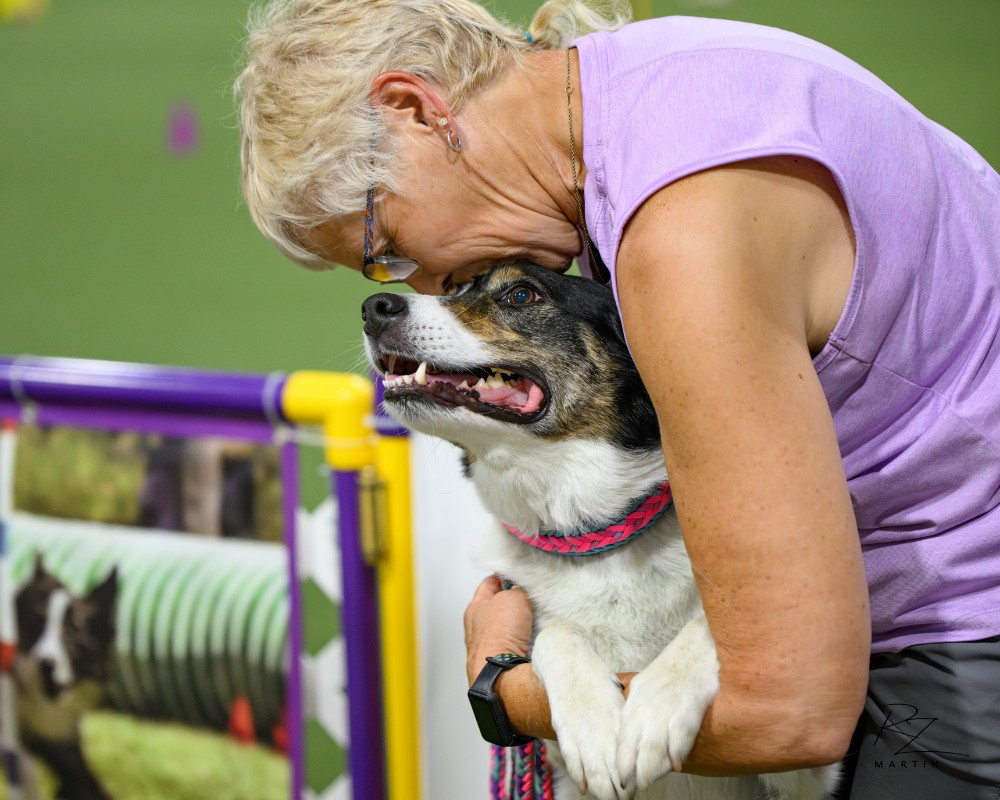
Story by Heather McShea
Photos provided by USDAA®
When most people hear “dog championship,” they might picture perfectly groomed dogs circling a show ring, waiting for a judge to decide which one is the best.
Agility is a very different kind of competition.
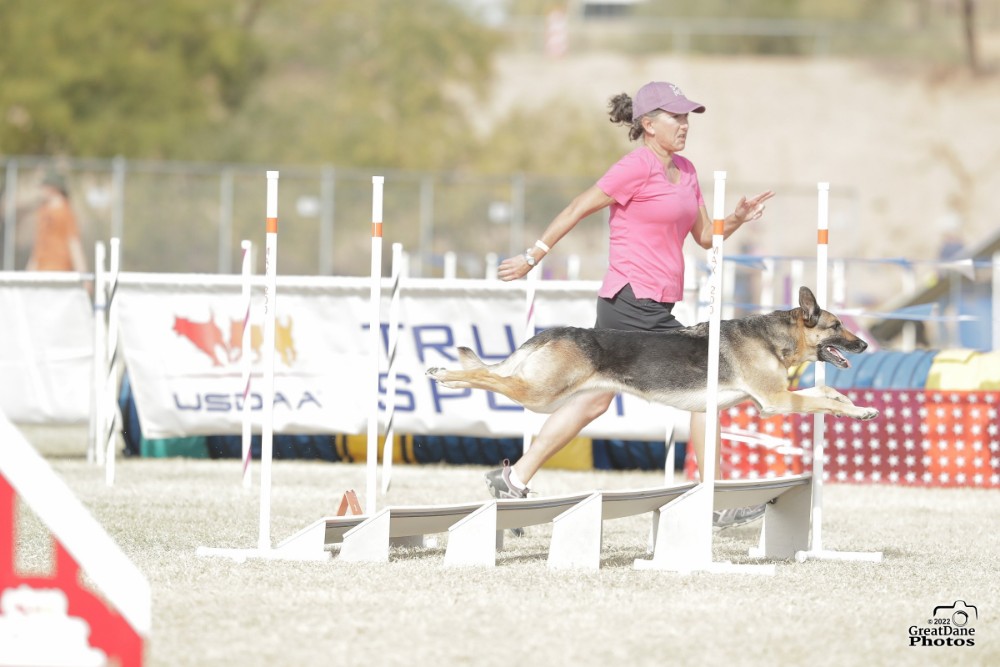
There are jumps, tunnels, weave poles and other obstacles. Dogs race through the course while their handlers guide them with movement, timing and verbal cues. It happens quickly, sometimes in the blink of an eye, and the slightest miscommunication can send a team off course.
But watch closely and you’ll see something far more fascinating than speed. You’ll see two teammates having a conversation without saying a word.
And some of the dogs competing at the highest levels of the sport began life as strays, rescues or foster dogs.
From Frightened Stray to Agility Pioneer
One of the most remarkable examples is Shannon, a little brown mixed-breed dog who appeared as a stray outside Stuart Mah’s townhouse. Estimated to be only six to nine months old, Shannon was so frightened that it took weeks to coax her closer. Eventually, a trail of dog biscuits led her into the garage, and into a very different life.
After beginning obedience training with Shannon, Stuart discovered that mixed-breed dogs had limited opportunities to compete in dog sports. Then, in 1989, he saw an agility demonstration. Shannon tried the equipment. She loved it!
Just five months after beginning training, Shannon and Stuart entered a United States Dog Agility Association® (USDAA®) event, finished second in Grand Prix® and qualified for the National Finals. At only their third show, they made the finals and placed sixth overall. Shannon went on to compete internationally, including at the FCI World Dog Show in Germany, where she placed third overall. She also won USDAA’s Grand Prix Finals and the Dog Agility Masters® tournament.
Her story helped embody an important idea at the heart of USDAA®, agility is a sport for “all dogs regardless of lineage.” In other words, a pedigree isn’t a prerequisite for greatness.
One Lucky Parking Lot
Years later, another rescue dog would prove the point.
Bekkah was found wandering in a parking lot in July 2018. She had no microchip, no collar and hadn’t been spayed. Eventually, she went home with Chris Meyers, who was looking for an agility dog. But Bekkah didn’t arrive knowing how to be a championship competitor. She and Chris had to figure each other out.
A few months after she came home, they entered a local USDAA trial simply to see how she would handle the environment. Bekkah qualified in Jumpers.
That first outing became the beginning of a remarkable partnership. Seven years later, Bekkah had earned championships in USDAA, AKC and UKI agility, three organizations offering agility competition – along with accomplishments in other dog sports. She competed in Barn Hunt, where dogs use their noses to locate safely-contained rats hidden among hay bales, and Fast CAT, a timed 100-yard dash chasing a lure. In October 2025, she earned three USDAA achievements at a single trial.
This amazing parking-lot stray had
Foster Fail to Champion!
Then there’s Cali.
If you’re familiar with rescues, you’ve probably heard the term “foster fail.” It’s what happens when someone agrees to temporarily care for a dog and then discovers that the dog has quietly become part of the family.
That’s Cali’s story. Lorry Minor agreed to foster a Doberman named Cali after she had been described by a pound as a fence jumper. Looking for a way to channel the dog’s energy, Lorry introduced her to dog sports. The foster arrangement didn’t exactly go according to plan. Ten years later, Cali was still by her side.
There is a little bit of Harry and Snowman in Cali’s story – the famous plow horse rescued from a slaughterhouse truck for $80 who went on to become a champion show jumper. Like Lorry, Harry saw something worth saving, took a chance, and discovered there was far more potential there than anyone expected.
Now 12½ years old, Cali has competed in agility, rally, Barn Hunt and Fetch Dog. Rally combines obedience skills and teamwork as dog and handler navigate a course together, while Fetch Dog is exactly what it sounds like: retrieving as a competitive sport. Cali continued trialing well into her senior years and was working toward her fifth PACH before retirement.
Lorry summed up their journey beautifully: Cali had inspired her, and she was glad she had taken a chance on her all those years ago.
Beyond the Jumps: A Bond in Motion
These stories reveal what makes agility skills so compelling.
It isn’t simply about how fast a dog can run or how high a dog can jump. It is about trust, training, focus and communication. The handler must guide the dog through an ever-changing sequence while the dog learns to read those cues and make split-second decisions.
Over time, that shared work creates an extraordinary bond. And that’s part of what makes the rescue stories so meaningful.
Shannon, Bekkah and Cali didn’t begin their journeys as polished competitors. They began as dogs who were frightened, homeless, overlooked or simply waiting for someone to take a chance on them.
Their beginnings didn’t determine
The World Games Comes to Tucson
This fall, Tucson will have the opportunity to watch some of the world’s top agility teams compete at the 2026 Cynosport® Dog Agility World Games Presented by Purina® Pro Plan®, November 11–15 at Kino Sports Complex.
Admission is free.
But the real reason to watch might have nothing to do with the scoreboard. You may come to watch an agility championship. But if you leave thinking differently about what a rescue dog is capable of, you’ve seen something even more remarkable.
For more news on USDAA® go to https://www.usdaa.com & https: